How Casino Culture in Tuyên Quang Entered Public Conversation
See how casino culture in Tuyên Quang moved through public conversation over time, from official language and tourism framing to local reporting and debate.
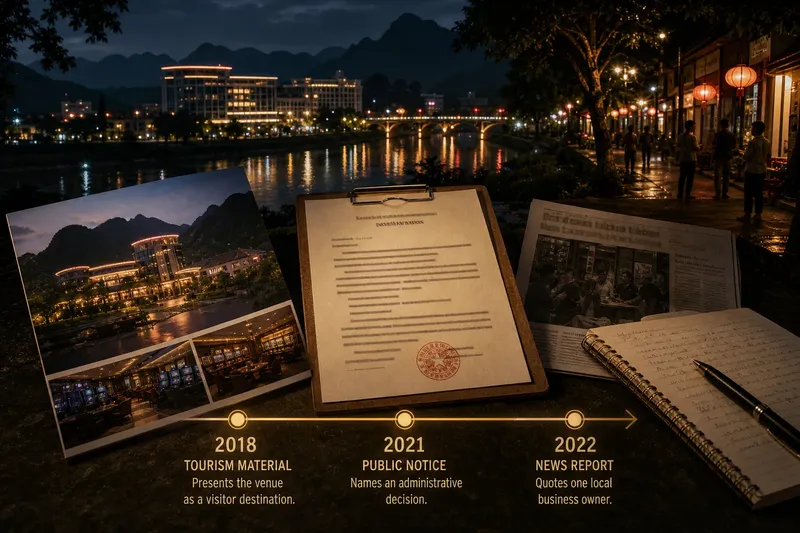
Casino culture in Tuyên Quang entered public conversation through changing descriptions of place, business, tourism, and public responsibility. The historical record matters because a notice, a promotional account, and a news report do not simply describe the same subject in different words; each brings casino activity into view for a different reason.
Public language shifts
There is no single public voice called “Tuyên Quang.” Official documents, tourism material, business descriptions, local reporting, and individual accounts have different authors and purposes. Reading them together can show how a casino-related place was framed, but only if their dates and contexts remain visible.
A useful history therefore follows changes in language rather than assuming a settled public attitude. An early administrative reference might treat a venue as a matter of regulation or licensing; later tourism copy might present it as part of a visitor offer. Those descriptions mark different public uses of the subject, not proof that one replaced the other.
Keep the date beside each claim. Without it, an old description can quietly pass for a current one.
From notice to narrative
Official notices tend to speak within a defined administrative scope. They may identify a decision, rule, or responsible institution, but they do not automatically reveal how residents discussed the matter. News accounts can widen the frame by connecting a decision to an event or local debate, while still reflecting the reporter’s chosen sources and emphasis.
Tourism and business language work differently. Promotional descriptions select appealing features and may present a venue as part of a broader destination. That language is evidence of how an organization wanted the place understood; it is not, by itself, evidence of the public’s response.
Imagine an invented sequence: an undated brochure calls a venue a visitor destination, and a later, dated public notice addresses its operating status. Record the brochure’s wording as promotional framing and the notice as an administrative statement. The sequence shows two ways the subject entered public language, but it does not establish a change in local opinion.
Chronology and evidence
Historical interpretation depends on distinguishing a dated event from a later description of it. A report published after an announcement may summarize or contest the announcement; it should not be treated as though it were the announcement itself. Likewise, a retrospective account may preserve useful context while reflecting the period in which it was written.
When assembling a chronology, note the publication date, the date of the event if stated, the speaker, and the type of source. If any of those details are missing, mark the gap rather than filling it with an assumption. This simple discipline prevents a collection of public statements from becoming a fictional timeline with unusually confident punctuation.
Keep event dates and publication dates in separate columns when building notes.
What does the timeline show?
Can a notice establish public opinion?
No. A notice establishes what its issuing body stated within the notice’s scope, not what residents broadly thought. Look for separately attributed reporting or individual accounts before describing public response.
How should older descriptions be used?
Attach each description to its publication date and source type. Use it to explain how the subject was framed at that time, not as a substitute for a current account.
What does tourism language tell us?
It shows how a writer or organization presented a place to visitors. It may reveal a promotional strategy, but it cannot stand alone as evidence of local reception or lived experience.
When do two accounts conflict?
Compare their dates, speakers, and purposes before treating them as contradictory. One may describe an administrative decision while another reports a later public response, so both can be accurate within different scopes.
Reading a public record
Use these checks to decide what a source can support. Each item ties an observable feature to a specific editorial choice.
- Date: Check for a publication date and, separately, an event date. If both appear, report them distinctly; if one is absent, label that part of the chronology uncertain rather than supplying a date.
- Speaker: Check whether an institution, business, reporter, or named individual is responsible for the statement. If the speaker is identified, attribute the claim; if not, describe it as wording in the document.
- Purpose: Check whether the text is an official notice, news report, tourism description, or business statement. If promotional, treat its persuasive wording as framing; if administrative, keep the claim within its stated scope.
- Event: Check whether the source names a concrete event or decision. If it does, connect the account to that event; if it does not, avoid presenting general language as evidence of a specific development.
- Public response: Check whether the source attributes views to identifiable people or groups. If it does, report the attribution and its limits; if not, do not convert institutional language into a claim about residents.
- Translation: Check whether a Vietnamese term or place name is translated. If the source form is available, preserve it alongside a clear explanation; if the translation is uncertain, say so instead of presenting it as an official name.
A short chronology
Say you are editing an invented file containing three items: a tourism leaflet dated 2018 that calls a venue a visitor destination, a public notice dated 2021 that names an administrative decision, and a news story dated 2022 that quotes one local business owner. These dates and descriptions are hypothetical inputs, not claims about actual events in Tuyên Quang.
- Enter the leaflet as 2018, source type “tourism material,” and claim “presents the venue as a visitor destination.” The observable result is promotional framing, so the decision is to describe how the venue was marketed, not how residents received it.
- Enter the notice as 2021, source type “public notice,” and claim “names an administrative decision.” The observable result is an institutional statement, so the decision is to attribute the decision to the issuing body and avoid treating it as evidence of community opinion.
- Enter the story as 2022, source type “news report,” and claim “quotes one local business owner.” The observable result is one attributed individual account, so the decision is to report that person’s view without expanding it into a general local position.
- Compare the three entries by date and purpose. The resulting account can say that the imagined file moves from promotional framing to an administrative statement and then to a reported individual view; it cannot say that public opinion changed, because the sources do not establish that.
This chronology makes a modest but useful distinction: it traces the kinds of public language present in the file while leaving unrecorded voices unclaimed.
History without false consensus
Casino culture in Tuyên Quang can be discussed historically by asking who described casino-related places, when they did so, and what each account was meant to accomplish. That approach reveals shifts in public framing without confusing promotion, administration, reporting, and personal testimony.
The most useful next source is the one that fills a specific gap: a dated document for an uncertain chronology, an attributed account for a missing perspective, or the original-language wording for a disputed translation. A careful history does not need to make every source say the same thing. It needs to show readers exactly where their accounts meet and where they stop.